
Auburn Wren: Leading with Creativity
Auburn Wren inspires YAMA students through trust, connection, and improvisation. She creates safe spaces where participants shed self-doubt, explore playful prompts, and experiment with instruments. By guiding students from comfort into growth, Auburn turns music-making into a practice of courage, collaboration, and leadership—where every act of creation becomes a lesson in life.
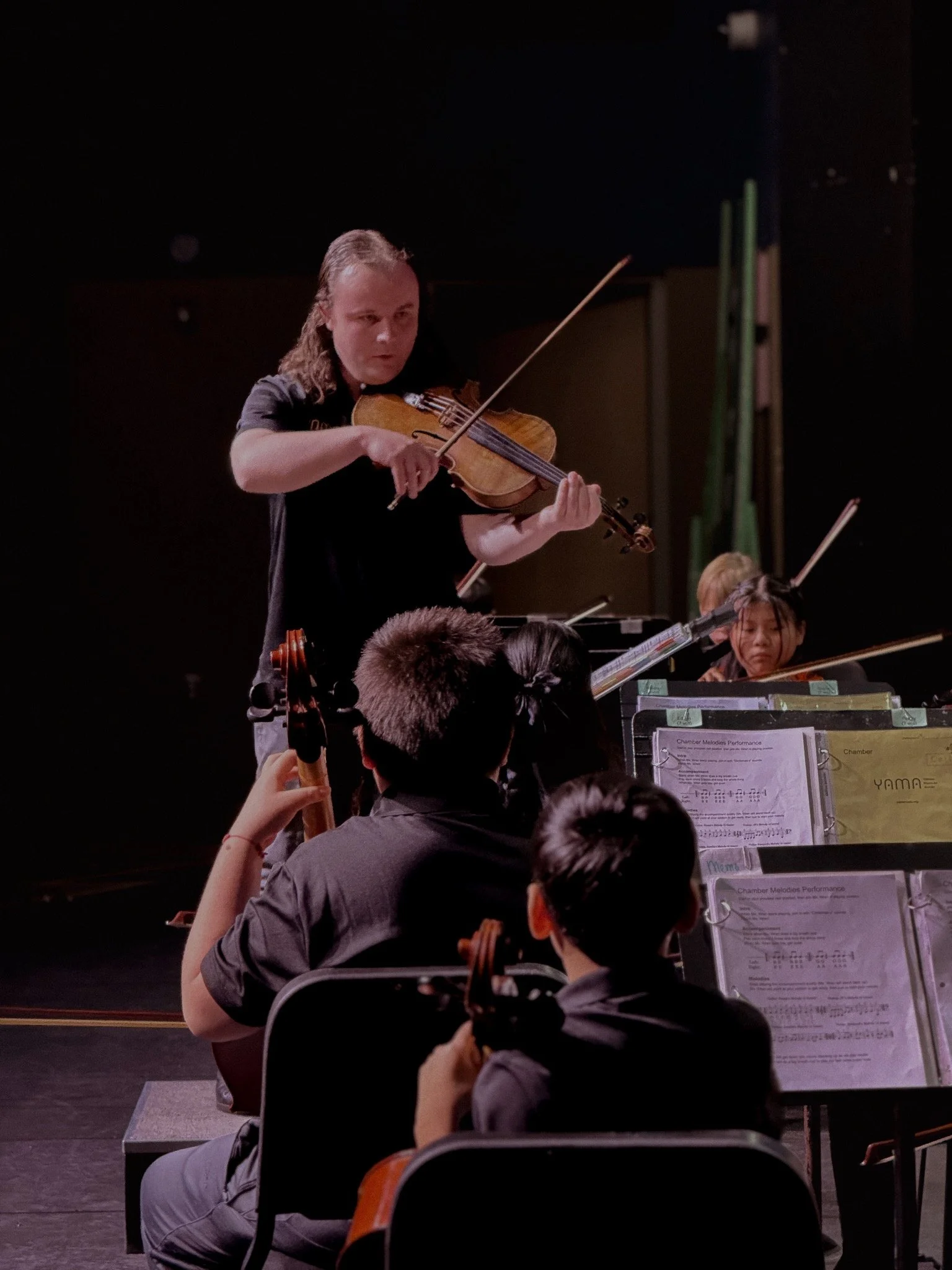
I belong to YAMA because I’m dared to form trusting, vulnerable, and dependent connections. Because I’m challenged to lead in the spotlight, from the back row, when I feel too small, and when I feel too big. Because I must learn by being in relation, by witnessing, and being witnessed. Because I exercise my right to thrive. I teach as a means to an end: to maintain my practice of community, and to remind myself that I am worth more than what can be extracted from me.
The process of creation is an act of love for what is becoming. It’s a craft that is wholly your own, yet it responds to others and has a knack for getting shared. Above all else, your creativity is inevitable, joyful, and deserves care. This is at the core of my teaching philosophy. The instruments and even music itself are simply the tools we have at our disposal. When we know the impact of our art, the motivation follows naturally.
When I’m at Garfield, my favorite activities center improvisation. By definition, improv requires its practitioners to create. And since it’s in the moment, there simply isn’t time for blocks like self-doubt or shame. To do anything at all, you’re required to lay your authentically creative self bare. It can be a lot to ask! The group needs a strong foundation of trust and safety before anyone within can show that kind of vulnerability, especially when we’re working with an artform that demands so much connection between mind and body.
I lean on anarchy in the improv spaces I facilitate. I like to start with a circle; it’s a shape with the same perspective no matter where you reside on it. Plus, shaking up the setup helps shake up the brain. If that’s not enough, we’ll also swap instruments to help give ourselves permission to make mistakes. From there, I guide the group through an easy repetitive song structure to serve as the comfort zone. Once we reach the edge between ease and boredom, we start working with prompts that challenge the structure. It’s here where people tend to leave the comfort zone into the learning zone. Each diversion from the norm takes an act of courage, and when you’re making up something new, there is no authority to tell you whether you’re right or wrong. Instead, you have to keep your senses open and witness your impact on others. This is where our practice of music turns into a practice of life and leadership.
